

Domestic Homicide Reviews and the role of financial organisations
Table of contents
In August 2025, PayPlan received our first Domestic Homicide Review (DHR) request relating to a client we were informed had passed away. While we were aware of DHRs as a concept, we had not anticipated the likelihood of a debt advice organisation being required to contribute to such a review. Nor had we established a formal process to manage a request of this nature or fully appreciated the depth, sensitivity, and intensity of the information required.
Once this review request was received, we immediately understood the responsibility of such a request and such high importance to providing accurate and accountable information.
This exact responsibility is referenced in the Domestic Homicide and Suspected Victim suicides 2020–2025-year 5 report [1], and Frank Mullane, AAFDA CEO said within this report, “You are the voice of the dead person, and you have a huge responsibility to ensure their story is recorded correctly. How can we learn from the past if it is not represented accurately “
What is a Domestic Homicide Review?
The definition does vary across organisations, but the Home Office defines a DHR as follows:
A Domestic Homicide Review (DHR) is a multi-agency review of the circumstances in which the death of a person aged 16 or over has, or appears to have, resulted from violence, abuse or neglect by a person to whom they were related or with whom they were, or had been, in an intimate personal relationship, or a member of the same household as themselves. Since 13 April 2011 there has been a statutory requirement for local areas to conduct a DHR following a domestic homicide that meets the criteria. [2]
Transition from DHR to Domestic Abuse Related Death Reviews (DARDR)
Further guidance from the Home Office is currently in draft form, but other organisations are already using the potential name change to reflect the inclusion of suicide, from Domestic Homicide Reviews to Domestic Abuse-related Death Reviews.
An example of what this is as follows:
Domestic Abuse Related Death Reviews (DARDR) were established on a statutory basis under section 9 of the Domestic Violence, Crime and Victims Act 2004 (DVCA 2004) and came into force on 13 April 2011. A DARDR is a locally conducted multi-agency review of the circumstances in which the death of a person aged 16 or over has, or appears to have, resulted from violence, abuse or neglect by:
- A person to whom he or she was related, or with whom he or she was or had been in an intimate personal relationship; or
- A member of the same household as himself or herself.
This includes where a victim took their own life and the circumstances give rise to concern, for example, it emerges that there was coercive controlling behaviour in the relationship. [3]
Scale and trends in domestic abuse-related deaths
In the annual report, the Domestic Homicide Project has recorded 1,452 deaths linked to domestic abuse over a five-year period, and 347 deaths in the year up to March 2025.
This is an increase of 85 deaths from the previous year, of which most are Suspected Victim Suicide Following Domestic Abuse. (SVSDA).
80 intimate partner homicides (homicide of an individual by a current or former intimate partner) have been recorded and 150 suspected suicides following domestic abuse were also recorded in the report (suspected suicide of a person following known domestic abuse against them).
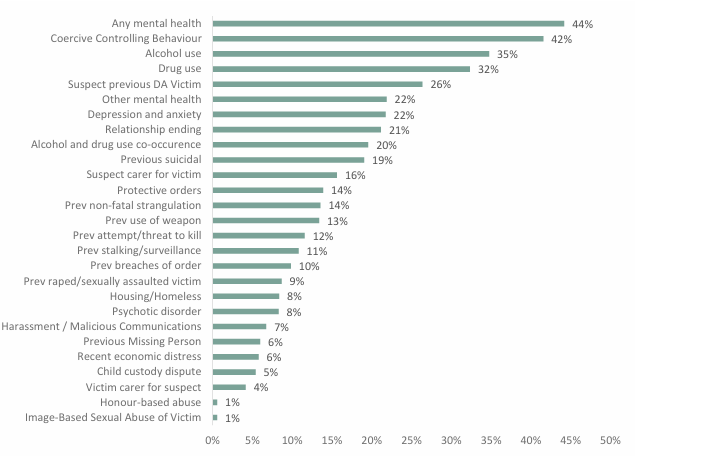
The report also looks at overall potential risk factors relating to the deceased and if there was any link to the domestic homicide or suspected suicide following domestic abuse.
The proportion of suspected perpetrators with recorded risk factors is included the following:
Economic abuse as an overlooked risk factor
Given the prevalence of economic abuse within domestic abuse relationships, it may be surprising to see recent economic distress as low as 6% , and new research from Surviving Economic Abuse revealed that economic abuse from an intimate partner played a role in over half of domestic abuse-related deaths, yet it’s routinely overlooked by the agencies that could have intervened to save lives. [4]
Key recommendations from Surviving Economic Abuse’s report include that “The Home Office should provide guidance on how non – traditional stakeholders including the financial services sector should engage with DHRs”.
Why this matters to financial organisations
We support this recommendation and as part of that support, with guidance from the Home Office not currently available, we see this as an opportunity to share our experience of being part of a DARDR, and to guide financial organisations in their own navigation of such a sensitive and important process.
Our data shows the trends in economic and domestic abuse disclosed and identified within debt advice, which evidences a year-on-year increase, culminating in the levels recorded in 2025:
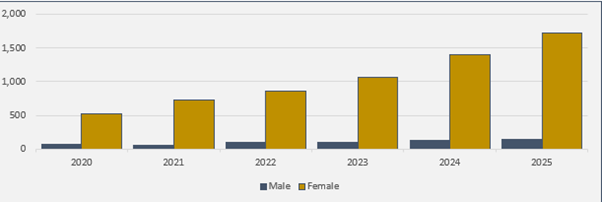
As this upward trend of disclosure and identification of domestic and economic abuse continues, court cases and the reporting of high-profile cases become more prevalent, the likelihood is that the volume of DARDR requests to be completed will continue, and more financial organisations will be asked to complete these.
Domestic Homicide Review: Our experience
The review:
- The DHR review request was received in August from the Police and Crime Commissioner from the county concerned, directly into our Human Resources department as a standard approach.
- This was escalated to the Vulnerability Lead and Safeguarding Committee after initial data request sharing concerns were addressed.
- The review consisted of a chronology of engagement that we had with the victim of the DHR concerned.
- This timeline also included questions about any awareness of domestic abuse, concerns for an adult at risk for the victim or suspected perpetrator, any concerns for a child at risk, any awareness of wider support needs, and any learnings that could be taken from our findings.
- The review was completed by the Vulnerability Lead and the manager of the operational team that had been supporting the deceased client, due to the sensitivity of the review and content required, with wellbeing always being considered.
- The review was returned to the Crime Commissioner within the required time scale.
- Further information was then requested by the DHR chair. This request included that additional information be provided to form part of the final report to identify where any lessons can be learned. It was made very clear that these may not be specifically for one agency, e.g. information sharing between agencies, no professional curiosity, etc. and that the review was not a fault-finding exercise, it was to identify the lessons that can be learnt and whether there is anything agencies could or should have done to support the victim of this review.
- This further review requested that an Individual Management Review (IMR) document be completed, which would inform the scope of the terms of reference for this review. Guidance was given on the IMR completion, and both reviews were password-protected due to the sensitive nature of the information requested. A draft document was also attached which encompassed all agency involvement, with queries identified for each separate agency involved.
- It was made very clear that the author of the IMR should not have had any direct involvement/management of the victim in this case, and that they must be independent. A deadline was also given for the IMR to be completed.
- Our reviews concluded that there was no mention of domestic abuse being disclosed or identified in communications with the client concerned.
- Following the submission of the reviews, we were invited to attend a panel discussion for all the agencies involved with the case.
The panel:
- The primary purpose of the meeting was to ensure accuracy of the report to date, and all the information provided was aligned by all the agencies completing the reviews, including complying with the statutory guidance on these reviews.
- Agencies that attended the review alongside us included Domestic Abuse Services, safeguarding leads, councils, children’s services, shelter housing, housing associations, housing officers, Police, Department of Work and Pensions, medical practitioners, NHS professionals, probation services, and community safety officers.
- A further panel meeting will be held later this year, once further information requested at the initial meeting has been received and its findings incorporated into the final review, demonstrating a lengthy process.
Key drivers increasing the likelihood of DARDRs
Our experience of DHR/DARDR has really brought to the forefront how important it is for non-traditional stakeholders to be aware of such reviews, and that the likelihood of receiving one by a financial organisation is becoming increasingly likely, for several reasons.
- The prevalence of economic abuse is a key driver; however, other significant factors include the growing level of media coverage and reporting on domestic abuse and related deaths, including homicide and suicide, as well as increased scrutiny of the risks identified by agencies and the actions taken to mitigate those risks.
- The current economic landscape, as the cost-of-living crisis continues and is recognised as the new normal, will also be a factor for financial organisations to consider and the increased potential for a DHR/DARDR to be completed.
- The sporting calendar of 2026 will inevitably be an influencing factor. Refuge, who we have partnered with for several years now, has written reports around the links between domestic abuse and sport, and that it isn’t the sport itself that causes domestic abuse, but that the tournaments and sporting events can aggravate pre-existing behaviours, so it’s a reality we all need to be aware of and react to accordingly. [5]
The steps that financial organisations have taken to identify and recognise domestic and economic abuse have been considerable, but the possibility of such reviews is a timely reminder that we must not become complacent and think our roles in this area are completed. We must all continue to evolve and ensure that policies and procedures incorporate such requirements.
Key considerations to consider:
- Domestic and economic abuse training needs to be included for all organisational areas to ensure customers and employees are identified and supported alike.
- Key indicators of domestic and economic abuse need to be included within the training, particularly within different means of communication and interaction – whether face to face, over the phone, or digital support – including the introduction of AI into customer journeys and the part it needs to play in recognising these indicators.
- An internal robust process designed in preparation for the possibility of receiving a DHR/DARDR to ensure the responsibility of completing this review is completed fully in the time parameter requested.
- Awareness and embedment of the process is paramount so that any area of the business in receipt of the review request is aware of what this is, the importance of the review, where to escalate and who is responsible for its completion.
- Vulnerability and HR policies need to be updated to reflect how an organisation would respond to another review and continually reviewed with key learnings from DHR/DARDR involvement.
- Continue to share best practice across financial organisations to support with our collective responsibilities in domestic and economic abuse awareness, highlighting new risks identified, particularly in line with ever-evolving tech abuse and AI, and the initiatives taken to mitigate and enhance support for customers needing wider support.
PayPlan’s actions and processes in response to the DHR/DARDR
We have taken steps in relation to our key learnings of completing a DHR/DARDR:
- DHR/DARDR is now included in internal training for full awareness, understanding and embedment. This includes induction-level and refresher awareness training sessions for all areas of the business.
- DHR/DARDR awareness has been added to our vulnerable client policy and HR employee Domestic Abuse policy alike.
- A robust process designed and in place, to be initiated upon receipt of a DHR/DARDR and embedded across the organisation, with continued monitoring in place.
- Enhanced wellbeing support is available for colleagues having direct involvement with the customer at the centre of the review and/or completing the review due to the sensitive nature and the impact this can cause on an individual.
- Continual review of the safe pathway into debt advice and collaboration with Refuge and our safeguarding consultant for ongoing support.
Our process
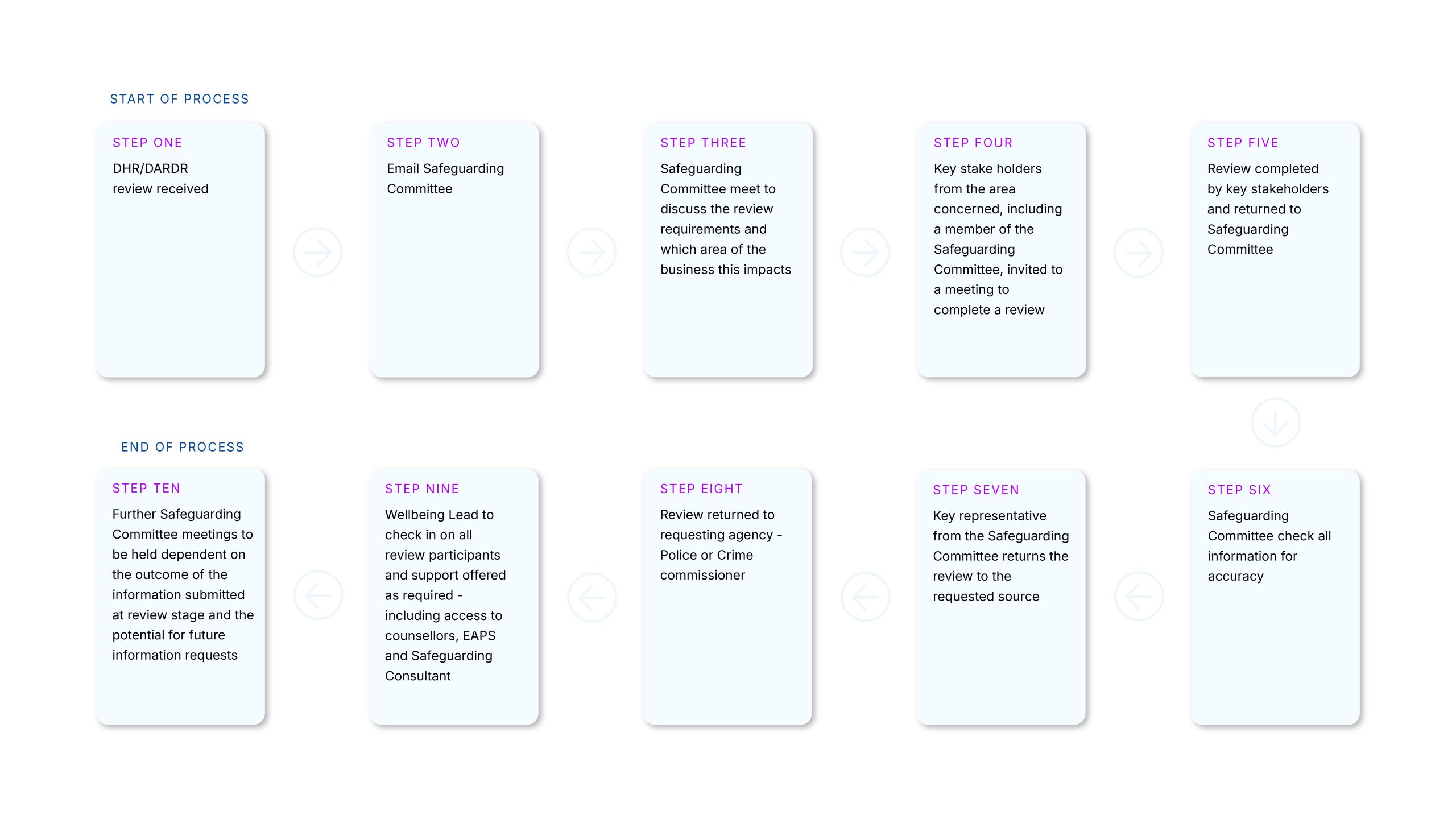
Our process takes all the above into consideration and has been cascaded to all areas of the business for full understanding and embedment.
The following diagram documents the process and reflects our experience:
The future
We will continue to collaborate with Refuge and continually work at improving our service and the safe pathway into debt advice for victim survivors of Domestic and economic abuse – that was our mission in 2019 and continues today.
Other focus areas for 2026 include:
- We’ve achieved gold status in the Lincolnshire Domestic Abuse Business. Engagement packages endorsing the support we have in place for our colleagues.
- To add to our wellbeing initiatives and colleague support.
- To continue to raise awareness of the support available in debt advice and to remove the barriers for individuals impacted by domestic and economic abuse.
- To continue to drive change and share best practice across financial organisations with our call to action.
Taking action to prevent future harm
The DHR /DARDR review is an evolving process as we all share our key learnings and help to shape the future of the roles of financial organisations. It’s early days but, in sharing our experience, our hope is that more organisations can be prepared for such a review, and despite all the safeguarding in place for customers who are the victims and survivors of domestic abuse, it’s one of continuous improvement.
We have decades of experience supporting vulnerable customers. But even we weren’t fully prepared for this. That’s why we’re sharing our learnings – so others can be ready.
What needs to happen next
- Raise awareness – recognise risks early
- Be prepared – build capability before a crisis
- Start open conversations – especially with policy and safeguarding teams
- Use expertise – learn from specialists, partners and peers
Because ultimately, the more we learn, the better we can prevent future harm and save lives.
[1] https://www.vkpp.org.uk/assets/Year-5-Report_FINAL-for-publication.pdf
[2] Home office – Domestic Homicide Reviews – KEY FINDINGS FROM ANALYSIS OF DOMESTIC HOMICIDE REVIEWS
[3] Domestic Abuse Related Death Reviews | OPCC
[4] Hidden-risks-fatal-consequences_Surviving-Economic-Abuse_2026
[5] As a football fan – and a domestic abuser worker – this is what I want you to know.